

Knowledge Base

Data Sharing

Welcome to the Data Sharing section of our Knowledge Base. This section provides important information, tools, and tips related to data sharing. Specifically, a lot of resources will contain information about Data Spaces. If you want to learn more about this, take a look!

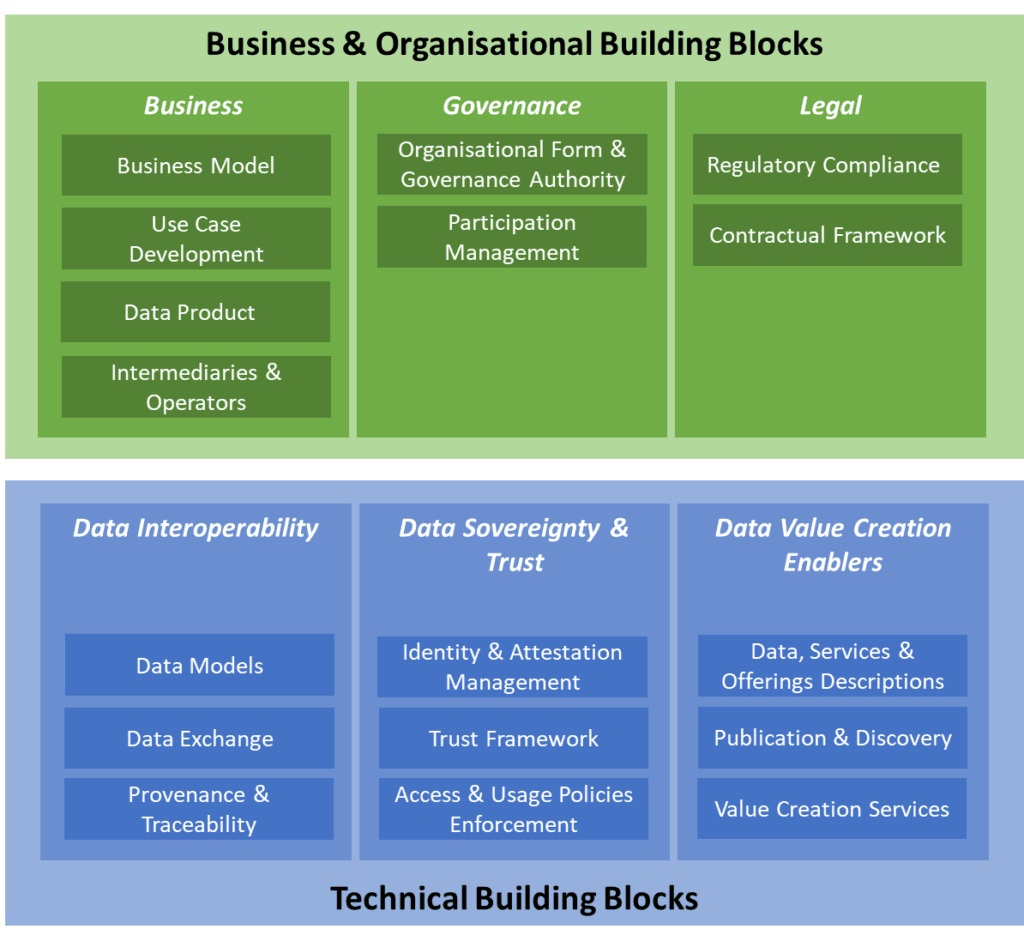
The Data Space resources are structured according to the building blocks of the the Data Spaces Support Centre Blueprint v1.5, which can also be seen below.
Filter

In this video we explain our work on the Paperless Bulk Transport use case focussed on cross-sectoral data sharing. This explainer video is created as part of the Living Labs of the Centre of Excellence for Data Sharing and Cloud (CoE-DSC).

Data Spaces Support Centre (DSSC)

This page explains the technical building blocks in the Data Spaces Support Centre blueprint. This can help understand the different categories within this building block, which is especially helpful when navigating our own business topic page.

Data Spaces Support Centre (DSSC)

This page explains the business and organisational building blocks in the Data Spaces Support Centre blueprint. This can help understand the different categories within this building block, which is especially helpful when navigating our own business topic page.

European Commission
The Data Governance Act (DGA) is a cross-sectoral instrument that aims to regulate the reuse of publicly/held, protected data, by boosting data sharing through the regulation of novel data intermediaries and by encouraging the sharing of data for altruistic purposes. 
S. Rossello, R. Díaz Morales, L. Muñoz-González (2021)

This article investigates some of the data protection implications of an emerging privacy preserving machine learning technique, i.e. federated machine learning. First, it shortly describes how this technique works and focuses on some of the main security threats it faces. Second, it presents some of the ways in which this technique can facilitate compliance with certain principles of the General Data Protection Regulation as well as some of the challenges it may pose under the latter.

K. Chawla (2024)

The dissertation explores the challenges users face in managing their privacy when using digital services, particularly focusing on the widespread but often disregarded cookie banners seen on EU websites. It proposes the development of Privacy Enhancing Tools (PETs) to empower users in controlling their personal data, merging insights from law, economics, and software development. Through six chapters, the research outlines a typology of control tasks users need to perform, identifies barriers they encounter, evaluates existing PET functionalities, and designs experimental tools to enhance privacy control, aiming to bridge the gap between legal rights and effective user empowerment in digital privacy.

CoE-DSC

This document outlines how Catena-X and the Smart Connected Supplier Network (SCSN) work together towards data space interoperability.

CoE-DSC

In dit whitepaper heeft het IP&T-team van Pels Rijcken – tezamen met technische experts van Linksight en TNO – deze juridische aspecten (in relatie tot de technische aspecten) van de inzet van MPC verkend. Gezien de grote hoeveelheid aan verschijningsvormen die MPC kent, is ervoor gekozen om twee specifieke decentrale MPC-toepassingen tot uitgangspunt te nemen in dit whitepaper, namelijk een specifieke vorm van ‘homomorfe encryptie’ (in dit whitepaper ook wel “decentrale homomorfe encryptie”) en een specifieke vorm van ‘secret sharing’, namelijk een die is gebaseerd op een ‘full threshold secret sharing scheme’ (in dit whitepaper ook wel aangeduid als “secret sharing”).

CoE-DSC

The text discusses the importance of data spaces and interoperability in unlocking the full potential of data sharing. It highlights challenges in semantic interoperability across data spaces due to varying vocabularies. The paper proposes using the Data Catalogue Vocabulary Application Profile (DCAT-AP) to standardize vocabulary exchange, aiming to enhance discoverability and facilitate federated searches across data spaces, ultimately supporting semantic interoperability.

Gaia-X

Gaia-X developed a Trust Framework and Labelling Framework that safeguard data protection, transparency, security, portability, and flexibility for the ecosystem as well as sovereignty and European Control.

The Trust Framework is the set of rules that defines the minimum baseline to become part of the Gaia-X Ecosystem. These rules ensure a common governance and the basic levels of interoperability across individual ecosystems, while giving the users full control over their choices.

The Trust Framework uses verifiable credentials and linked data representation to build a FAIR knowledge graph of verifiable claims from which additional trust and composability indexes can be automatically computed.

Netherlands AI Coalition (NL AIC)

This guide actively supports organisations with challenges regarding data sharing for AI applications. This guide focuses on the guidelines and building blocks to interconnect data spaces. 

Netherlands AI Coalition (NL AIC)

This guide actively supports organisations with challenges regarding data sharing for AI applications. In doing so, this guide focuses on the guidelines and building blocks for individual (sectoral, application-specific) AI data spaces.

eOppiva

This quiz is an entry into the European data economy: an area of the economy where the collection and use of data play a central role. Thereby, it indirectly points towards the need for data spaces from a legal, European perspective. It explains more about the data markets act and data services act as well as the role digital giants and how Europe should be competing against them.

CoE-DSC

Parties interested in deploying a data space need to use the right technologies and need to make sure they get the business and governance of the data space right. This is easier said than done, because there is relatively little guidance on how to deploy a data space successfully. What guidance can be given? On behalf of the CoE-DSC, a white paper has been written about this topic by Gijs van Houwelingen et al., TNO.