

“Increasing labour productivity or improving efficiency? Those kinds of objectives don’t exactly get my heart racing.” With that observation, Caroline van der Weerdt, Senior Consultant at CoE-DSC/TNO and lead of the Data Sharing Valorisation & Velocity Programme (Data SVP!), immediately highlights what she sees as the core challenge facing many data sharing initiatives. Considerable effort is being invested in interoperability, standards and infrastructure, but far less attention is being paid to demonstrating the real-world benefits these developments deliver. The Data SVP! team aims to change that. According to Caroline, the greatest challenge for many initiatives lies not in the technology itself, but in making its value visible.
Putting the end user, not the technology, at the centre
According to Caroline, discussions around data sharing are still too often driven by technology. When she joined the programme earlier this year, she was sent a range of websites, videos and presentations. What immediately stood out to her was how similar the stories were. “What I mostly read and saw were people talking about how impressive and promising the technology was,” she says. “But my first thought was: where is the user in this story? Where is the truck driver whose working day becomes easier because of this? Where is the patient receiving better care? Where is the employee who genuinely notices the difference?” In Caroline’s view, the value proposition often remains too abstract. “We frequently link data sharing to KPIs that hardly anyone feels emotionally connected to,” she explains. “Think of improving efficiency, increasing productivity or strengthening competitiveness. But data sharing has the potential to achieve far more significant outcomes because it enables greater transparency and citizen participation.” She points to examples such as improved collaboration in healthcare, smarter energy management and even strengthening democratic resilience.
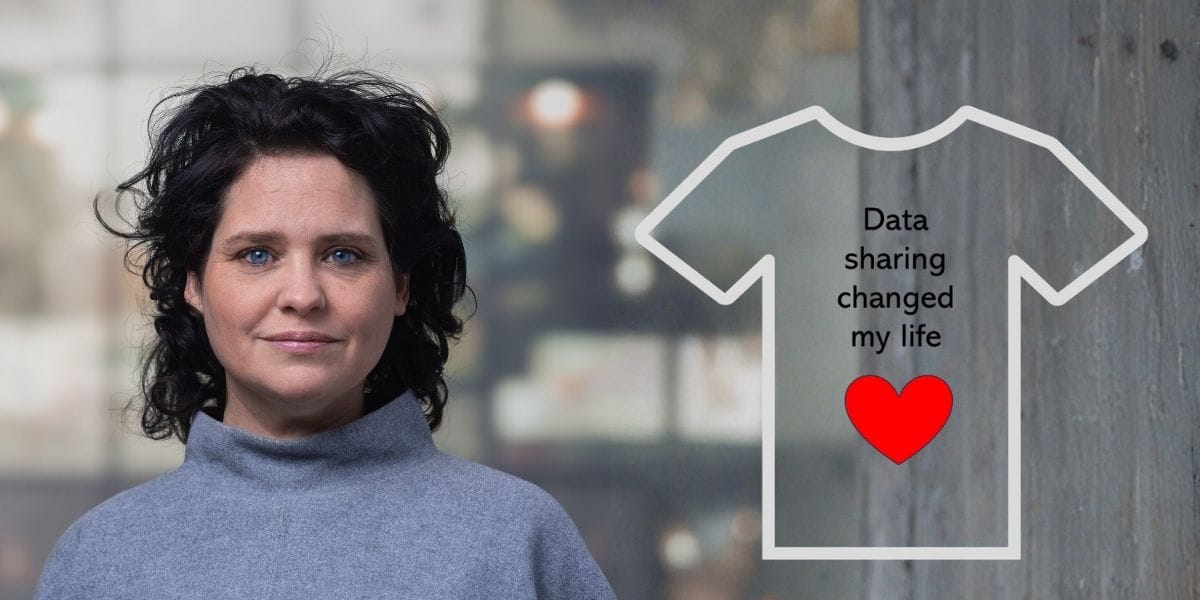
A familiar example of data sharing in everyday life is the pre-completed tax return. Tax authorities combine information from employers, banks and benefits agencies, allowing income, savings and mortgage information to be largely populated automatically. Citizens only need to review and, where necessary, amend the information. This reduces administrative burden and improves user experience. At the same time, Caroline believes this example demonstrates the substantial potential for data sharing to create more direct and visible value in other areas of daily life. “We simply don’t hear enough of those stories. During a recent presentation, I showed a slide with the words: ‘Data sharing changed my life.’ Because ultimately, isn’t that what this is really about?”
Two tracks to help data sharing initiatives accelerate and scale
This observation also forms the foundation of Data SVP!. “While previous data sharing initiatives focused primarily on interoperability and technical standards, we explicitly look at how these solutions can generate social and economic value,” Caroline explains. “We are now reaching the point where we need to demonstrate why people and organisations would genuinely want to participate.”
To support initiatives at different stages of development, Data SVP! operates along two tracks: Velocity and Valorisation. The first track, Velocity, focuses on organisations that are still in the early stages of developing a data sharing initiative. The emphasis is on accelerating collaboration and experimentation. “Sometimes organisations first want to explore whether data sharing delivers value at all,” Caroline explains. “We provide tools and expertise to make the value proposition explicit and help validate it with the people who are actually expected to benefit from it.” Data SVP! is also developing an incubator environment that provides access to elements of the required infrastructure, enabling organisations to experiment with data sharing and explore its benefits with relatively low barriers to entry.
Caroline adds: “Important partners within the Velocity track include service providers that offer, for example, connectors enabling organisations to join a data space, or identity verification services. It is also in our interest that, as adoption grows, these providers gain access to an expanding market for their services.”
The second track, Valorisation, focuses on initiatives that have already demonstrated their potential. Here, the central question is how successful pilots can evolve into sustainable solutions. How do you attract new participants? How do you demonstrate value to investors, users and other stakeholders? And how do you ensure an initiative does not remain dependent on subsidies? “There is an enormous amount of unlocked potential within most data sharing initiatives,” says Caroline. “But when funding programmes come to an end, uncertainty often arises. The question becomes: what next? Why should other parties join? Why should organisations invest? Those questions reveal that the value proposition has not yet been made sufficiently tangible.” This is why Data SVP! helps initiatives sharpen and better communicate their value proposition. “Essentially, we have said: let’s work together to determine how to make that value visible,” Caroline explains. “Not only for investors or policymakers, but especially for the people who will ultimately use the solution or experience its benefits.” Storytelling plays an important role, as does identifying interventions that can accelerate adoption. The programme also supports business development, audience analysis and dissemination activities, helping successful initiatives move beyond the pilot phase and achieve sustainable growth.
Impact challenge: five trailblazers making their value proposition tangible
During the Data Sharing Festival earlier this year, the team launched an Impact Challenge, inviting organisations to rethink and strengthen their value proposition. Five data sharing initiatives* ultimately joined the programme as “trailblazers”. Together with these organisations, Data SVP! is exploring how value creation can be made visible in practice and which approaches are most effective in supporting further scale-up. The lessons learned are intended to benefit other data sharing initiatives as well.
One of the trailblazers is Health-RI, a data sharing initiative focused on the sharing of secondary health data. One of its applications involves an oncology solution that enables clinicians to make treatment decisions based on broader datasets. “Decision-making becomes less protocol-driven and more data-driven,” says Caroline. “But this also changes the relationship between doctor and patient. Patients may take on a more active role in discussions. Doctors need to explain treatment options differently. New dynamics emerge.”
As a result, the focus shifts to questions such as: What behavioural changes arise? What support is needed? And how can people be enabled to adapt successfully? These are topics with which participants are not always familiar, but which Data SVP!’s experts understand well. “We create an open and creative environment where participants can reflect on the real impact of their solutions.” According to Caroline, Health-RI demonstrates particularly well that successful data sharing solutions are not solely about technology, but also about how people work with and benefit from it.
Social impact as the ultimate goal
For Caroline, the ultimate objective of Data SVP! extends well beyond helping initiatives accelerate and scale. Success is ultimately measured by social impact. “What matters most to me is that people genuinely experience improvements because of a data sharing solution,” she says. “That a patient gains faster access to the right treatment because healthcare professionals can make better use of available data. Or that a municipal service desk employee can help a resident more quickly because information is no longer scattered across multiple systems. Or that a truck driver enjoys a smoother working day because logistics partners share information more effectively.” According to Caroline, end users do not even need to know which technology or infrastructure makes these improvements possible. “What matters is that people notice processes becoming simpler, services improving, and decision-making becoming easier. That is when data sharing has truly fulfilled its promise.”
Become the next success story
Would you like to make the value of your data sharing initiative more explicit for prospective customers, participate as a service provider, or explore the opportunities created by data sharing? If so, please get in touch with us via info@coe-dsc.nl or directly with Caroline at caroline.vanderweerdt@tno.nl. We begin with an intake session to understand your specific needs and objectives. Together, we then define the goals and expected outcomes of our collaboration. An in-kind contribution from participants – meaning active collaboration without direct financial exchange – is also possible. Naturally, we share the results and lessons learned publicly, contributing to greater visibility of the potential of data sharing.
* In addition to Health-RI, our trailblazers include the data sharing initiative Edu-V, service providers Innotractor and Triply, and the European project INSIEME. Keep an eye on our website for their stories.