
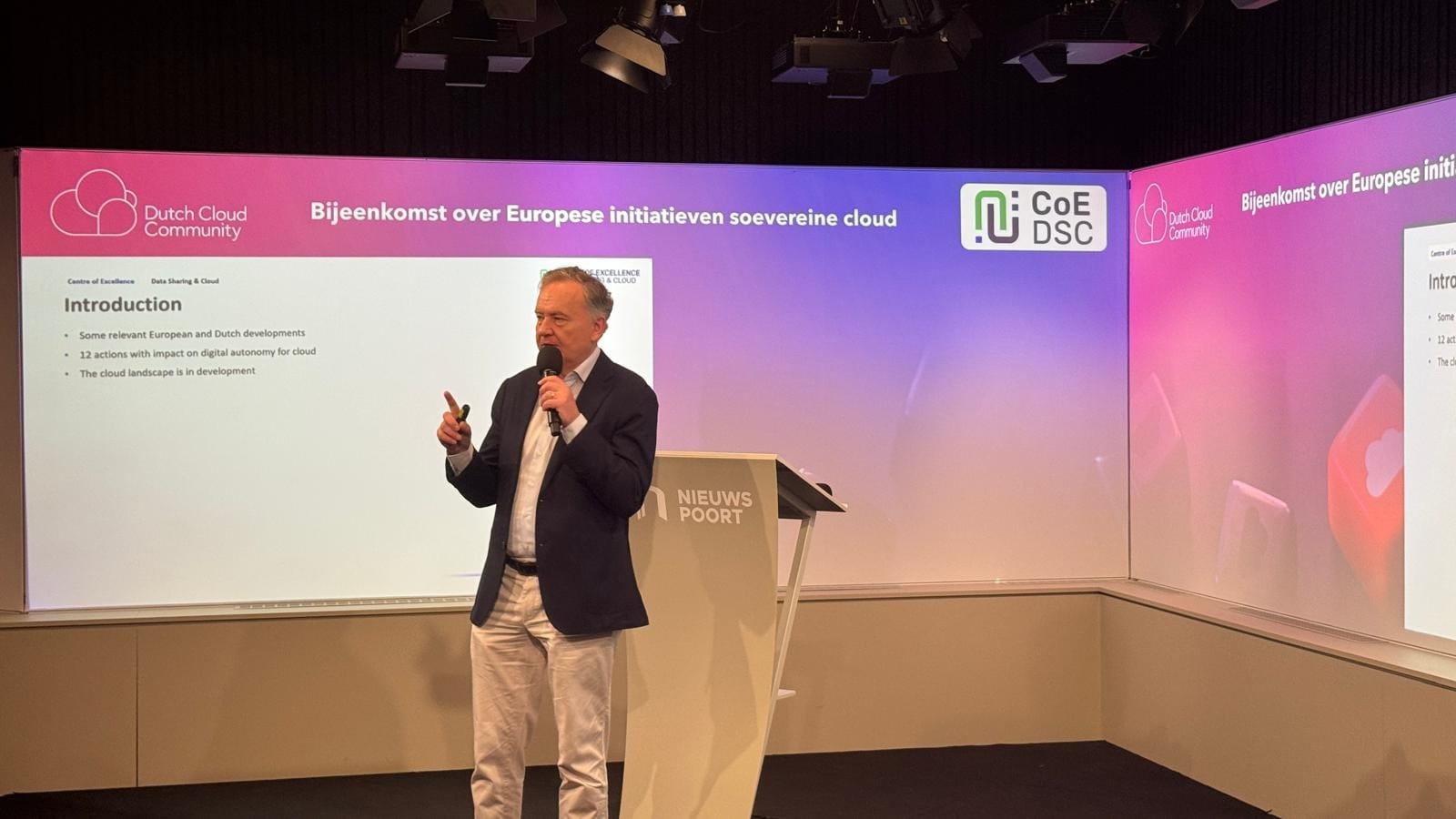
On June 18, 2025, together with the Dutch Cloud Community, we organised a meeting on European initiatives for a sovereign cloud.
The reason for this meeting is the widely shared observation that Europe has become increasingly dependent on non-European cloud suppliers. By outsourcing almost all digital infrastructure to American parties, not only has our own knowledge been eroded, but the investment power in European alternatives has also seriously lagged behind. As a result, we have created a situation in which our digital dependency makes us vulnerable; a risk that is becoming increasingly urgent in the current geopolitical context.
ARTICLE IN iBestuur ON THIS MEETING (NL)
The central question
The central question during the meeting was: What steps are needed to break this dependency? And who should take the initiative?
Coe-DSC: 12 actions with impact on digital autonomy for cloud
During his introduction, Björn Håkansson took us through the relevant European and Dutch developments and the ’12 actions with impact on digital autonomy for cloud’.
EuroStack: both European government and technology sector need to join forces
“Europe cannot solve this with regulation alone,” said Cristina Caffarra of EuroStack. “Both governments and the European technology sector need to work together.” Governments will need to take concrete steps by purchasing more European from providers that meet the requirements of digital sovereignty. At the same time, there is also a task for the sector itself to better structure the supply and to work together.
The subsequent speakers came up with answers to the questions… and they were hopeful.
Dynamo Cloud: this challenge needs collaboration
For Francesco Bonfiglio, CEO of Dynamo Cloud, the sector can take up this challenge through collaboration. Dynamo works as an aggregator of services: if the customer needs service A and B, but his supplier can only deliver A, then that provider can source service B from a colleague via Dynamo and deliver it to the customer as a single package, under similar conditions, with the same requirements and certifications. Dynamo is now in its second year, the network of affiliated companies is growing and the potential is considerable! Ultimately, Dynamo is intended to become a Public Private Partnership, making it transparent and easily accessible to everyone.
BIT: one of the participants in the Dutch IPCEI project ECOFED
While Dynamo focuses on the commercial and legal aspects of a cooperative cloud, the Dutch IPCEI project ECOFED is working on the technical aspects of such a partnership. Wido Potters of BIT, one of the participating companies, showed what such a partnership could look like in practice: an interface in which users can fill in technical and functional requirements, which are then automatically matched to the offerings of other providers. The result is a distributed cloud in which data, but also workloads and virtual machines, can be automatically ported from one provider to another. It is already running, it is already working, and it is being further developed.

Leaseweb on the European Cloud Campus
Robert van der Meulen of Leaseweb took the attendees through another Dutch IPCEI project, the European Cloud Campus. This project focuses more specifically on the offerings of providers. In order to offer a fully-fledged alternative to the clouds of the hyperscalers, it is important to further develop the offering in breadth. And that is what the ECC project focuses on: Database as a Service, Containers as a Service, etc. Developing a wide range of services that parties can use to seamlessly connect to the needs of the user. ECC also focuses on educating and training young people to ensure that the necessary knowledge that we so desperately need remains available in Europe.
RVO on Dutch and European funding
Finally, Christiaan Meinsma of the Netherlands Enterprise Agency (RVO) concluded on an optimistic note. Although the Netherlands is not participating in the next IPCEI round, there are other trajectories in which the Netherlands and the European Commission are investing heavily in European infrastructure in the field of cloud, communication and networks.
The conclusion of the afternoon was clear: there are already many initiatives that are working on a future-proof, European cloud infrastructure. The urgency is high, and the momentum is there. Now it is time to move forward!
We would like to thank all speakers and Topsector ICT for supporting this event.