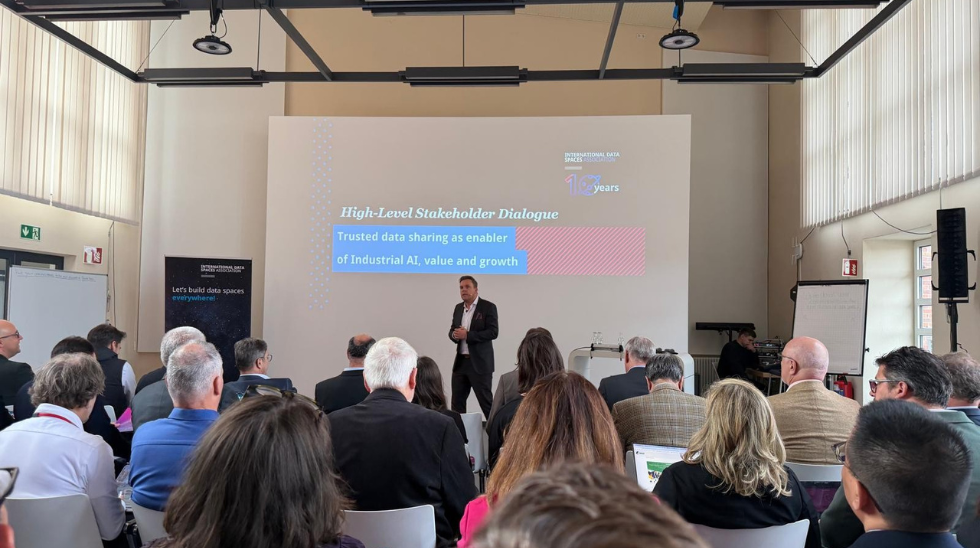
On 3 November, international thought leaders and pioneers from the data sharing ecosystem gathered in Berlin for the High-Level Stakeholder Dialogue and Data Spaces Decade Forum organised by the International Data Spaces Association (IDSA). Peter Verkoulen, Director of CoE-DSC, represented the Dutch ecosystem. Berry Vetjens, Director Digital Innovations at TNO, was one of the IDSA board members who took the stage.
The event marked ten years of IDSA and focused on a question that will become increasingly important in the years ahead: how do we move from proven technology and successful applications to the large-scale adoption of data spaces? The dialogue was therefore designed to lead to concrete commitments and joint actions, rather than knowledge exchange alone.
Towards large-scale adoption
The foundations for trusted data sharing are already in place. Common architectures, open standards and operational applications demonstrate that organisations can share data across organisational boundaries while retaining control over their own data. This means the challenge is shifting. The question is no longer whether trusted data sharing is technically possible, but why we want to share data and how we can enable many more organisations to
participate.
This requires, among other things, effective governance, sustainable funding and business models, standardisation, straightforward onboarding and political engagement. If these conditions are successfully put in place, data spaces can develop into a trusted data layer for AI, innovation, and economic and societal value creation across sectors such as mobility, energy, healthcare, agriculture and supply chains.
Stronger connection
Berry Vetjens and Peter Verkoulen contributed to the discussions in Berlin on this next phase of data spaces, where stronger connections between the Netherlands and Europe are becoming increasingly important. After all, value chains and data flows do not stop at national borders.
By bringing Dutch knowledge, practical experience and needs into the European dialogue, while connecting European developments back to the Dutch ecosystem, we can accelerate the transition towards interoperable and scalable data sharing.
The commitments made in Berlin will be developed further through working groups focusing on the various topics over the coming months. Key opportunities to follow the progress are the Simpl Annual Community event in Brussels on 10 December, the Data Sharing Festival in The Hague on 27 January, and the Data Spaces Symposium in Brussels on 9/10 March.
Catena-X: supporting companies in taking the next step
Ahead of the High-Level Stakeholder Dialogue, the Catena-X Supplier Onboarding Day took place as part of the IDSA Data Space Accelerator programme. Catena-X demonstrates the tangible value that participation in a data space can offer companies across the automotive supply chain. The Accelerator programme provides practical and financial support to help
companies take part.
Since the programme started this summer, around 160 new companies have joined, expected to reach 500 to 600 by the end of the year. Of these companies, 63% are SMEs. With the right support, SMEs too can find their way into data sharing ecosystems and benefit from the opportunities they offer.
After a long period of pioneering, a solid foundation is now in place. The next challenge is clear: moving from experimentation and frontrunners to broad participation and demonstrable value in practice. Together with its Dutch and European partners, CoE-DSC will continue to contribute to making that transition possible.