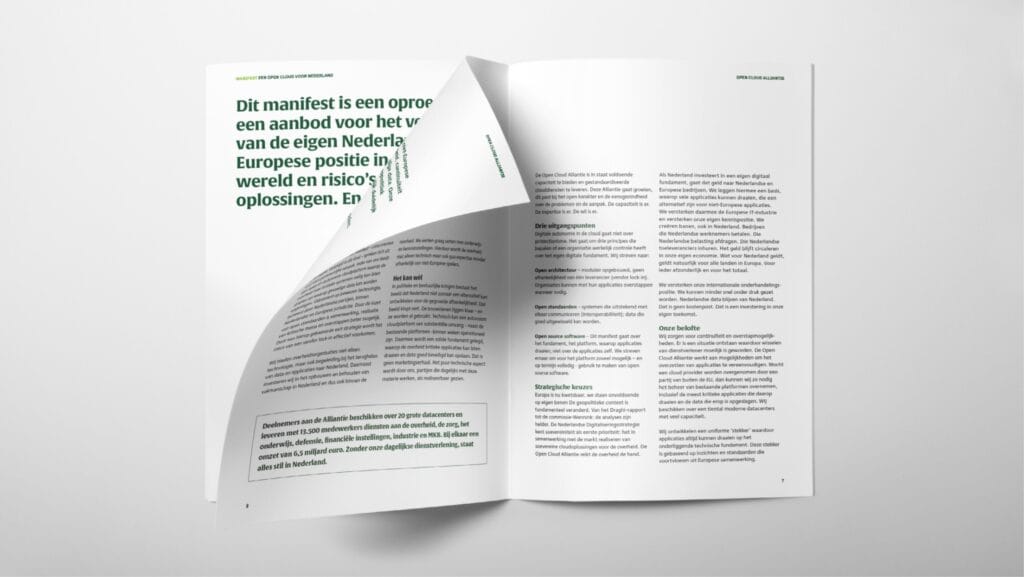

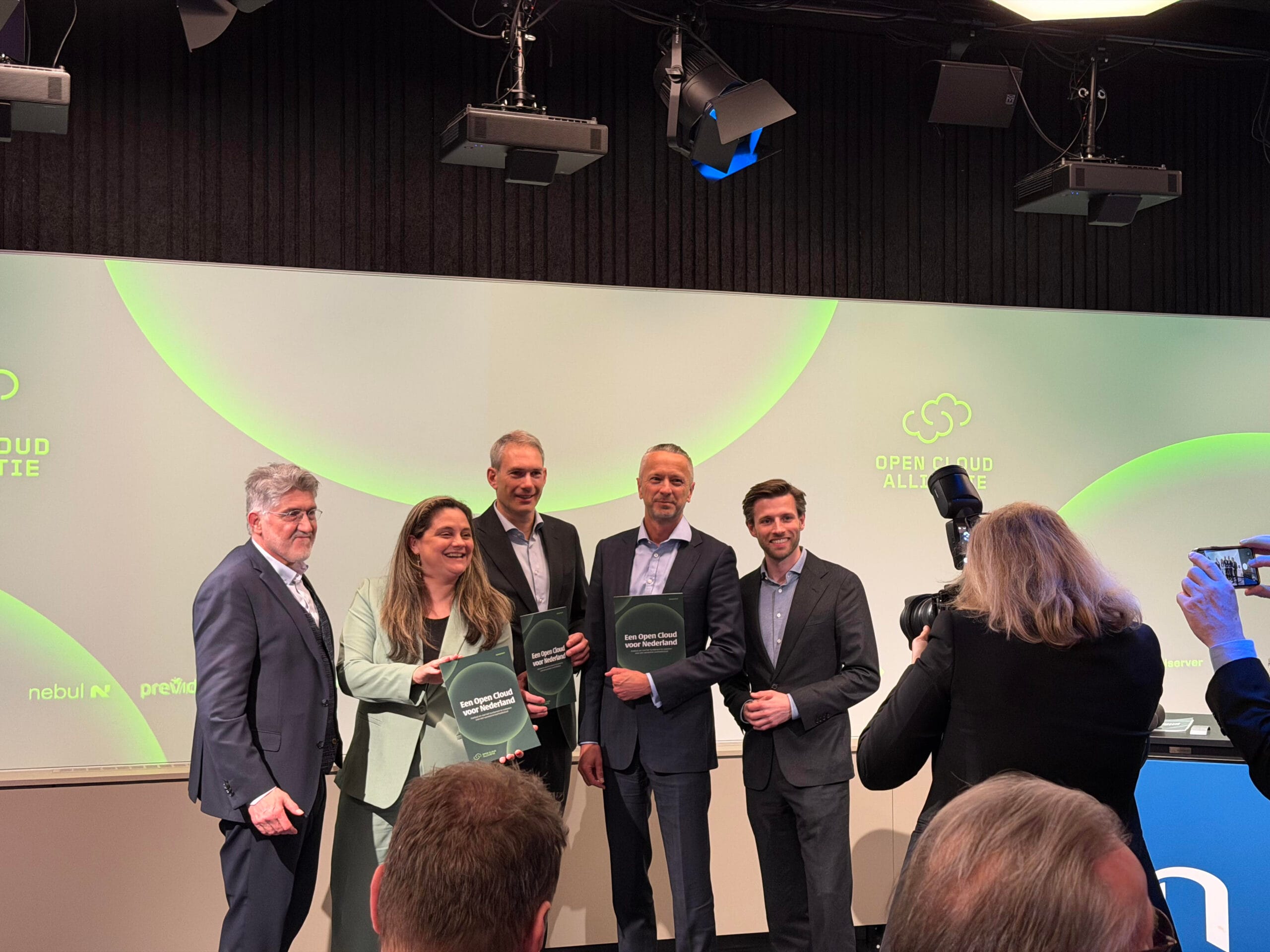
Today, the Open Cloud Alliance (in Dutch: Open Cloud Alliantie, OCA) presented a manifesto for a sovereign government cloud to Michiel Boots, Director-General for Economy and Digitalisation at the Ministry of Economic Affairs and Climate, Barbara Kathmann, Member of the House of Representatives and of the standing committee for Digital Affairs, and Nathan Ducastel, Chair of the Dutch Digitalisation Strategy Council.
According to the manifesto, the IT companies involved to date each offer an autonomous cloud platform capable of securely hosting critical systems and sensitive data within a matter of weeks.
Concrete and actionable
The Netherlands still relies heavily on non-European cloud providers. This entails risks: national information systems may become vulnerable to geopolitical pressure, while substantial ICT budgets flow abroad each year.
The new OCA offers a concrete and actionable alternative: cloud platforms under Dutch and European jurisdiction, built on open standards, open-source software, and an open architecture—principles that CoE-DSC has long promoted across the cloud ecosystem.
What does the manifesto say?
The alliance calls on government organisations to use their procurement power strategically to strengthen the Dutch and European IT sector, with digital sovereignty as a key consideration. Recently, Member of Parliament Barbara Kathmann also made this appeal during the Data Sharing Festival. The manifesto urges strict requirements for privacy and information security in the procurement of new services.
OCA emphasises the importance of adhering to open standards, enabling organisations to collaborate more easily and switch between providers without barriers. It also advocates intensifying public-private cooperation. The alliance calls for concrete action to begin migrating critical applications and sensitive data to sovereign Dutch and European cloud providers.
Now is the time to act
The required technology and capacity are already available through modern, scalable data centres across the Netherlands—ensuring immediate deployability as well as greater resilience against cyber threats, outages, and network congestion.
The founding members of OCA are Centric, Info Support, Intermax, KPN, Nebul, Previder and Uniserver. The ambition is to expand this with partners from the broader cloud ecosystem, underlining the importance of open standards. By pooling knowledge and expertise, rapid progress can be achieved. At the same time, this allows the government to invest in a strong Dutch and European IT sector—an ambition also strongly highlighted in the Draghi report.
Peter Verkoulen, Director of CoE-DSC, said: “Collaboration is vital here. ‘Working together’ is key: no single party can solve this alone. We need to take concrete action rather than remain stuck in discussions and paperwork.
The open initiative launched today will hopefully grow quickly into a thriving ecosystem of Dutch and European companies—not only on the supplier side, but also among users. Just a few weeks ago, major Dutch banks indicated that they too attach great importance to reducing their dependence on a small number of non-European hyperscalers. This is truly about working together towards greater digital sovereignty.”
CoE-DSC participates
OCA is supported by the Digital Infrastructure Netherlands Foundation (DINL) and TNO. CoE-DSC also fully endorses the manifesto and is keen to contribute to its implementation and expansion.
Verkoulen added: “We do this, for example, by connecting the broader Dutch cloud ecosystem to this initiative, and by actively building links with European providers and the European Commission. We are also looking very specifically at how Gaia-X labels can help implement the OCA requirement for a European headquarters—after all, that is precisely what Gaia-X was designed for.”