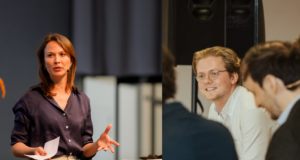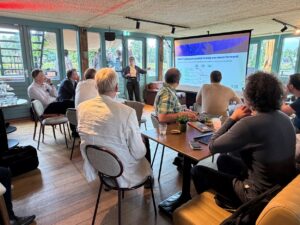

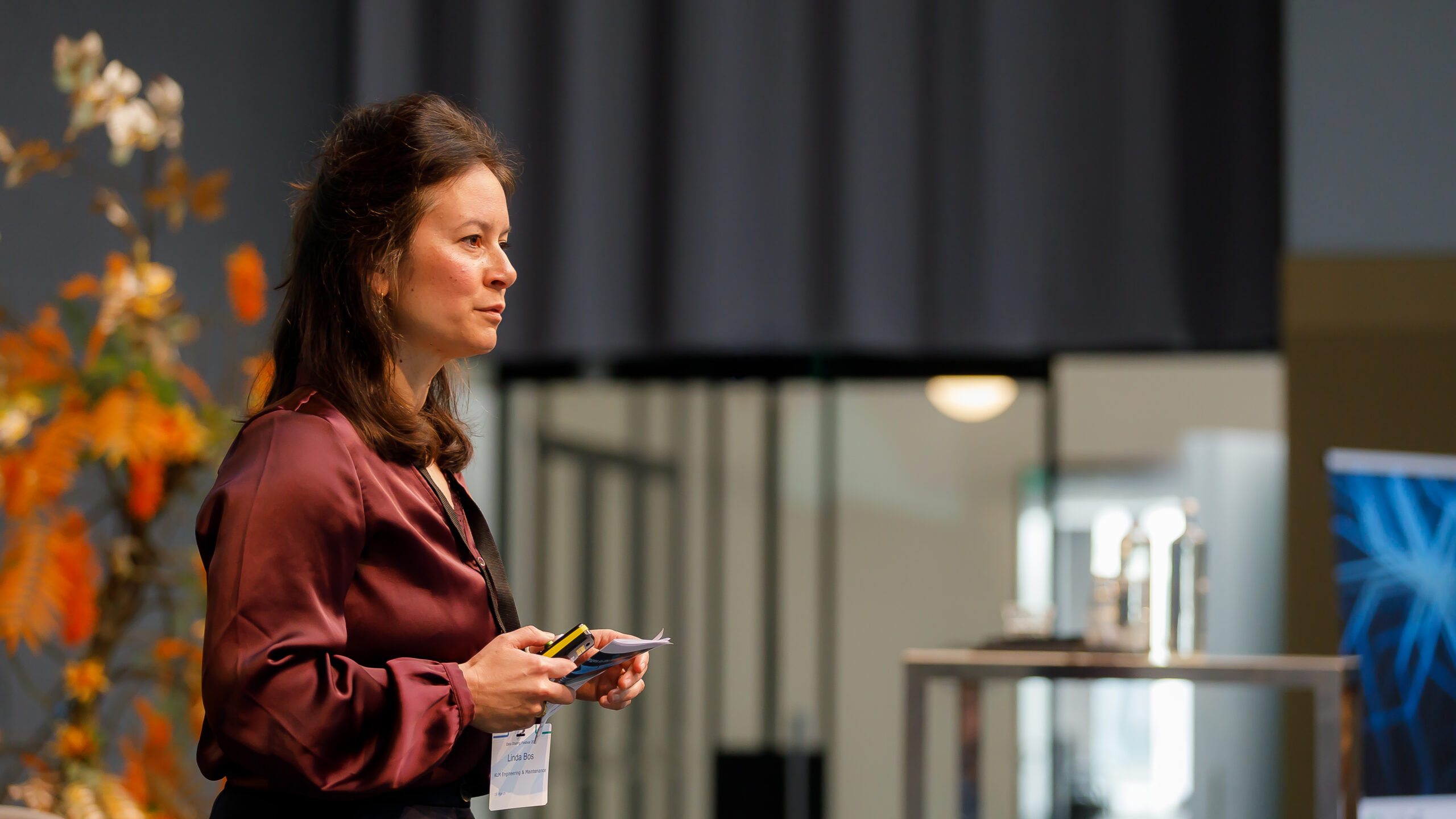
Linda Bos during her presentation on Hyperion at the Data Sharing Festival in March 2026. Photo: Peter Putters.
Aviation cannot afford to wait for a new generation of aircraft before becoming more sustainable. Electric and hydrogen-powered flight will only become realistic in the longer term, while aircraft being purchased today will remain in service for decades. The sector therefore also needs to make progress in the shorter term by using existing aircraft and components more intelligently, efficiently and for longer.
For Linda Bos, Director of the KLM Engineering & Maintenance Technology Hub, the solution lies not only in developing new types of aircraft, but also in how organisations collaborate and exchange data. Through the Hyperion project, KLM is working with the Royal Netherlands Air Force, the Royal Netherlands Aerospace Centre (NLR), OneLogistics, ILIAS and InnoTractor to explore how data-driven collaboration can contribute to more sustainable and future-proof aircraft maintenance.
“Many developments in sustainable aviation are focused on 2040 or 2050,” Linda says. “We are deliberately looking at the nearer future as well, towards 2030. We know that the new era of sustainable aviation will not arrive tomorrow. That is why we are focusing on technological applications that are already available but are not yet, or only rarely, being used within the Maintenance, Repair and Overhaul (MRO) sector.”
Making the existing fleet more sustainable
The KLM Engineering & Maintenance Technology Hub was established at the end of 2021 to connect the various innovation initiatives within KLM Engineering & Maintenance. The maintenance organisation employs around 5,000 people across four business units – Airframe, Engine Services, Component Services and Engineering – each with its own innovations, technologies and challenges. The Tech Hub identifies connections between these initiatives and translates technological developments from outside the organisation into applications for the maintenance operations of tomorrow.
Hyperion is one of the projects in which this approach is being put into practice. This public-private partnership explores how secure data exchange can contribute to smarter, more efficient and more sustainable aircraft maintenance. Data Spaces, Digital Product Passports (DPPs) and AI are important building blocks, but they are not ends in themselves. Ultimately, the project is about enabling organisations to exchange data securely and collaborate without relinquishing control over their own data.
According to Linda, Hyperion is part of a much broader development within aviation. For many years, innovation in the sector was primarily driven by new generations of aircraft. Every technological leap required new maintenance expertise and repair techniques. Linda believes the next innovation curve will look different. “We are reaching the end of that S-curve. The next leap will no longer be about a new type of aircraft, but much more about how organisations collaborate. We are moving towards an AI-driven and increasingly autonomous operation. That requires collaboration across an ecosystem of companies, knowledge institutions and government bodies. This collaboration and exchange of data provide the foundation for sustainability initiatives.”
From fragmented data to smarter maintenance
An aircraft component goes on a long journey during its lifetime. It is manufactured by one company, used by different airlines, maintained by repair organisations and may change hands several times. Yet the information available about that component does not automatically travel with it.
Linda explains: “Every party holds part of the maintenance history, technical data or information about how the component has been used. What is more, that data is spread across numerous systems – not only within KLM, but also at other maintenance companies and logistics providers. As a result, there is often no complete and up-to-date picture of a component’s condition. Information such as the number of flight hours and when a component was repaired is shared, but further details are often missing. This could include the exact materials used in a repair, how extensive the repair was or the regions over which a component has flown. All of this data can provide greater insight into the health of a component and help us predict more accurately when it needs to be replaced.”
Hyperion is exploring how organisations can make this information available in a controlled way. “We want to enable data-driven collaboration between all relevant parties in the supply chain so that we can organise aircraft maintenance more efficiently and sustainably. This requires clarity about which data is shared, who is permitted to use it and what information is provided in return.” A Digital Product Passport could play an important role in this. Whereas information currently transferred with a component mainly consists of basic data, such a passport could eventually also provide insight into its maintenance history and condition. This would allow maintenance organisations to determine more accurately when a component needs to be inspected, repaired or replaced, enabling components to remain safely in service for longer. This is known as predictive maintenance.
Before organisations can share data, however, they must first be able to generate, store and analyse it. According to Linda, this remains a significant challenge. “For many components, we still do not have sufficient insight into which data they generate and what that information tells us about their condition. New inspection technologies produce not only measurements but also photographs and other images. Existing IT systems are not always designed to handle these. Only when the entire chain is in place can applications such as predictive maintenance be deployed more widely.”
The technology works – now the organisation needs to follow
The first phase of Hyperion focused on developing connectors that enable data to be exchanged securely between different organisations. A demonstrator is now in place, showing that this is technically feasible. Attention is therefore shifting to a more difficult question: how can this way of working become part of everyday operations?
Organisations need to agree on what information they are willing to share, who retains ownership of the data and how intellectual property and commercially sensitive knowledge will be protected. This makes Hyperion much more than a technology project. “Technically, we have demonstrated that it works,” Linda says. “But within KLM, that is where the questions really begin. What is a Data Space? Does our data remain ours? How do we deal with intellectual property, legal matters and governance? These are the areas we now need to focus on much more closely.”
Linda also sees a clear gap between the speed at which technology develops and the pace at which an operational organisation can adopt and implement new technologies. For employees maintaining aircraft every day, a Data Space is not necessarily a familiar concept. The new approach therefore needs not only to be developed technically, but also to be made understandable and practical. “From the Tech Hub, we are at the forefront, while day-to-day operations move at a different pace. There is a significant gap between the two. We are asking a great deal of operational teams in making that transition. Some people embrace new innovations immediately, while others need a little more time. That is entirely understandable.”
Hyperion can only scale through collaboration
The next phase of Hyperion will focus on developing concrete use cases and establishing shared agreements that make those use cases possible in practice. What information should be available when a component is transferred? What agreements should apply between a maintenance organisation, repair shop, supplier or owner? And how should these agreements align with data-sharing standards that are themselves still evolving?
“This requires an ecosystem-wide approach,” Linda emphasises. “We cannot do this alone. Experience shows that a lack of trust and short-term thinking are the main reasons why we have not yet solved this. No single party can solve it on its own, and we need to take a long-term view.”
Hyperion is therefore developing a governance framework for the MRO ecosystem. By 2028, the concept is expected to have been demonstrated and validated in a realistic environment. Standardisation, implementation and scaling will follow. Collaboration across the triple helix is essential: government (the Dutch Ministry of Economic Affairs and the Netherlands Enterprise Agency, RVO), industry (both civil and military) and knowledge institutions (NLR). Linda therefore expects widespread adoption to become realistic only in the years after 2030.
Precisely because this development takes time, the sector needs to start now. Aircraft purchased today will remain in service for many years. The digital and organisational infrastructure required for smarter maintenance therefore needs to be built now, particularly because new sustainable aircraft concepts will not be available at scale in the short term.
No organisation can achieve this transformation alone
For Linda, it is clear that KLM cannot make this transition independently. Legislation, international standards and digital infrastructures are developed beyond the boundaries of any single organisation. At the same time, different partners possess expertise that KLM does not have entirely in-house.
According to Linda, this is also where the Centre of Excellence for Data Sharing & Cloud (CoE-DSC) adds value: by connecting organisations and sectors facing similar challenges. Experience from other industries can help accelerate developments within aviation. The CoE-DSC also creates connections with companies and organisations outside the Netherlands. “We cannot and should not do this alone,” Linda says. “Legislation, regulation and standardisation largely sit outside our own operations. We need other parties, but we do not always know how to establish those connections. That is precisely where I see the added value of the CoE-DSC. Events such as the Data Sharing Festival and the upcoming Digital Product Passport Festival show that very similar challenges exist across a wide range of sectors. Industries that are already further ahead with Digital Product Passports, for example, can offer experience and lessons from which aviation can learn.”
Working today towards a more sustainable future for aviation
Hyperion demonstrates that making aviation more sustainable does not depend solely on new aircraft. While those new technologies are still some way off, there is a significant opportunity to make smarter use of the existing fleet. By sharing data securely, organisations can collaborate in new ways and plan maintenance more effectively. In doing so, the sector can start taking meaningful steps towards a more sustainable future today.