

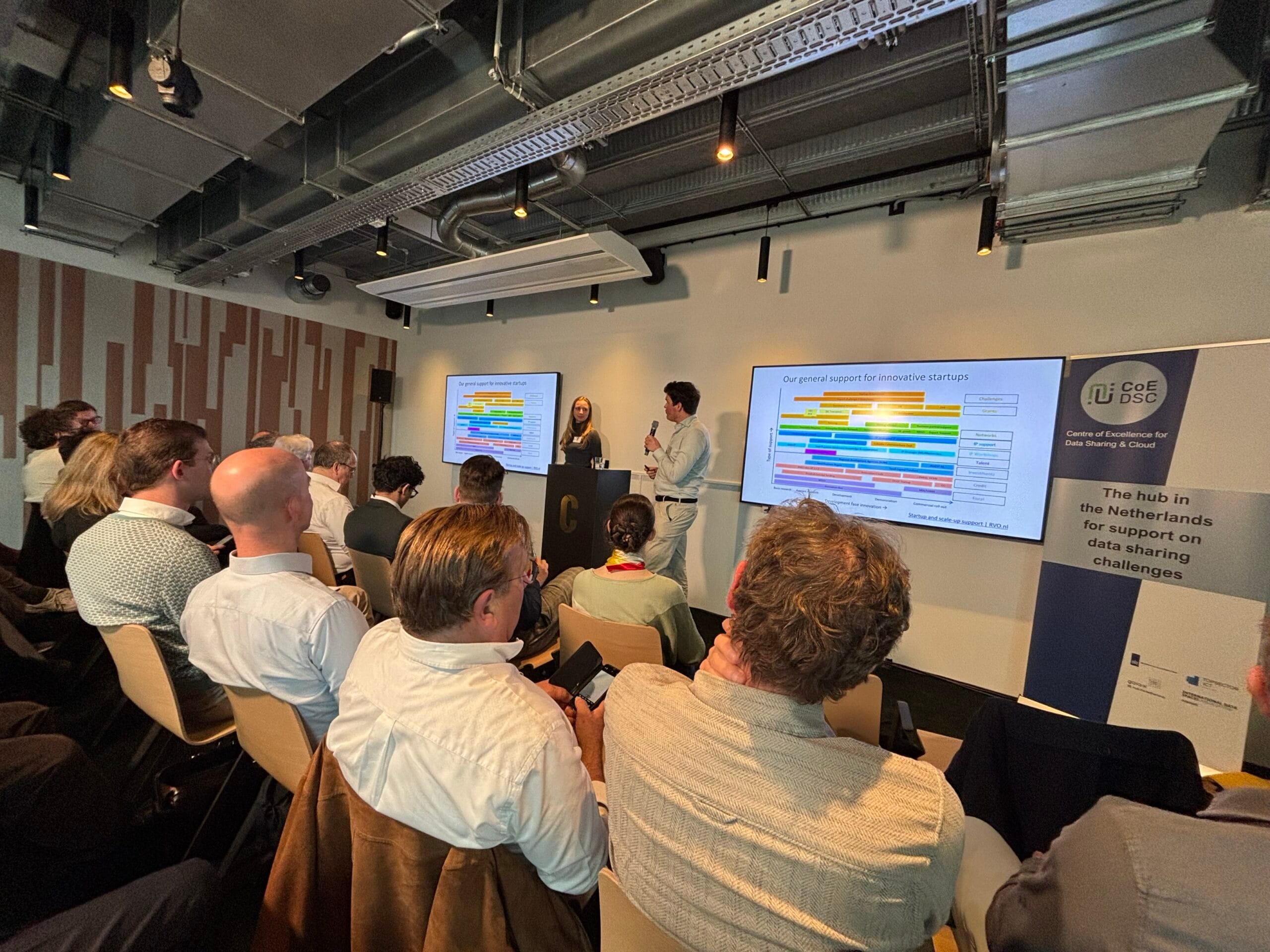
On March 25, 2025, our Community Meeting was focussed on DSIC: the future and pillars of Interoperabilty. During this event in Utrecht, we looked into the DSIC future plans. We also shared more of the 3 major pillars propelling interoperability on the national level: standardization, funding and regulatory views.
Agenda & Main Takeaways
Part 1. DSIC Future and Plans: Next steps
by CoE-DSC – Gijs van Houwelingen & Yekaterina Travkina
- Following the progress made last year with the Data Spaces Interoperability Compass (DSIC). In 2025 we are starting a creation of the Dutch Scheme Agreements to aid interoperable development of the Dutch data sharing landscape.
- We begin by organizing a Steering Committee and a Sounding Board by gathering commitment from mature initiatives, service providers and policy makers. In the meantime, we work with the expert group and previously gathered community input to shape the first version of the agreements framework.
Stay in touch with the team to be involved with the DSIC updates or reach out via info@coe-dsc.nl
Part 2. DSIC Use Cases: Input from the community
by CoE-DSC – Ewout Bouwman & Daniel Scheepbouwer
CoE-DSC continues supporting our community with the use cases:
- By offering in-kind neutral guidance, we advise and support you in overcoming strategic technical and organisational challenges, helping you to drive your initiative toward success.
- By guiding data sharing initiatives through a collaborative use cases development, in return we share the interoperability lessons learned back to the community.
If you have a challenge or an idea for a use case that CoE-DSC can support you with, please come in touch with Daniel Scheepbouwer (via daniel.scheepbouwer@nimblenova.com)
Part 3. From EU to NL and back – 3 Pillars of Interoperability:
Funding opportunities – National & European Instruments
by RVO – Maria Deetman & Okke Scholten
- Data spaces funding requires a creative approach, as traditional means do not always align. Direct innovation projects often get funding more easily than infrastructure such as data spaces.
- Collaboration is key to funding – look for funds and subsidies that encourage collaboration. Look especially at European and national schemes that focus on cross-sectoral and international collaboration.
- By looking creatively, there are more funding opportunities than you might think – both nationally and internationally.
- National/regional: RVO can help find subsidies such as MIT, Interreg and regional funds.
- International: EU programmes such as Eurostars, Horizon Europe (HE) and Digital Europe DEP offer opportunities.
If you are interested to learn more about funding and RVO support, reach out to teamiris@rvo.nl
Regulatory view – impact from DA & DGA
by TNO – Kartik Chawla
- The EU regulatory landscape is evolving with a wide range of legislation, where any organization can be under different roles and ‘hats’. But the incoming efforts at coordination and standardization are under the EU Competitiveness Compass.
- Through Data Act and Digital Governance Act, EU is providing increased access to data but with protections for data users and for connected products by default (i.e. for their users, and for third parties selected by the users). Those protections are in place from PSBs (Public Sector Bodies) through Data Intermediation Service Providers (DISPs) and Data Altruism Organisations (DAOs).
You can use DSSC regulatory compliance flowchart to help navigate the regulatory landscape in your context. Connect to Kartik Chawla to read more about his work in the field.
Standardization efforts – CEN & CENELEC JTC 25
by Geonovum – Ton Zijlstra
- Efforts are being made under the EU Data Strategy to propel the EU single data market. Besides legislation, there are standardization efforts guided by NEN norm commission and JTC25 workgroups with regards to data spaces, data governance, and cloud/edge, where national efforts are integrated into EU context.
- This requires action from different Memberstate stakeholders via strategic/tactical involvement in standardization workgroups, acquiring practical experiences, and conviction to good practices.
- For that, here are three questions to think about:
(1) Where is it key to have influence at European level choices / implementations?
(2) Where is it ok to follow the output of European choices made by others?
(3) Where are both not possible, and do you need to chart your own course?
Join the NEN Normcommissie, where you can vote at the Dutch level, and participate as an expert in EU Working Groups. (For more see: https://www.nen.nl/data-act)