This content was created by the Data Sharing Coalition, one of the founding partners of the CoE-DSC.
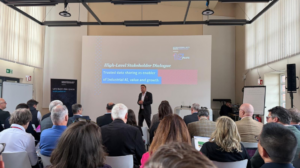
On the 30th of June, our monthly Community Meeting took place. Several participants of the Data Sharing Coalition gathered at the La Vie Meeting Center in Utrecht to discuss data sharing challenges they currently experience or have experienced in the past and to share ideas and best practices. It was refreshing to see everyone in person again.
During a Community Meeting, one of our participants usually presents a specific data sharing topic, for example a data sharing use case they have realised. However, in this edition, we used a different format. We organised an UNconference. This is a participant-driven meeting without predetermined topics. The attendees define the agenda and choose the topics they would like to discuss. In general, this results in increased interaction between the participants compared to a “regular” presentation.
Defining the agenda
The agenda was defined by the attendees. They had the opportunity to briefly introduce and pitch a topic of their preference. Afterwards, the attendees voted for the topics they wanted to place on the agenda. The topics that received the most votes were included in the time slot.
Various topics were suggested and were rephrased into questions. This included questions such as: “How does the Data Sharing Coalition fit in the international ecosystem?”, “What types of data archetypes are there?”, “How can we build a common sandbox?”, and “How can we scale up our current use cases?”

After defining the topics, attendees split up into two groups to discuss their topic of interest. In total, there were two parallel time slots which allowed the participants to join two sessions. Due to the interactive nature of the meeting this resulted in fruitful conversations with many new ideas and connections. A big thank you to all attendees for participating, joining the discussion and sharing your valuable input. Below you will find a few comments from attendees on the newly introduced format:
Robert Zuijdwegt, Cronos Amsterdam: “The UNconference was refreshing, it differs from a normal meeting which makes it more interactive and fun.”
Willem Koeman, Amsterdam Economic Board: “It is a good format that enables you to listen, adjust the conversation and make connections with people.”
Peter Verkoulen, Gaia-X Hub The Netherlands: “This meeting has helped me to think in a different way and gain new insights.”
Would you like to join a (UNconference) Community Meeting? Please send us an email: info@coe-dsc.nl – even if you are not a participant (yet).